The whale as Leviathan
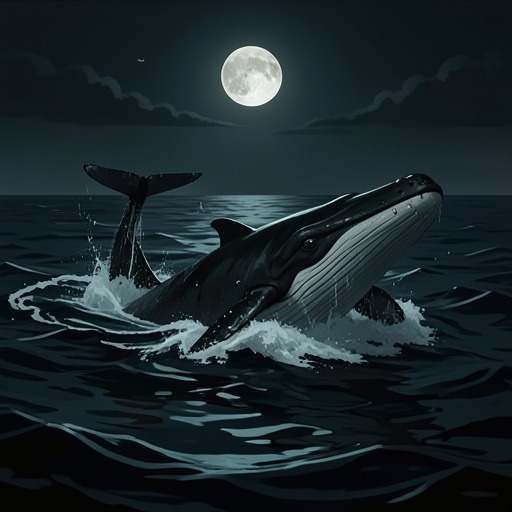
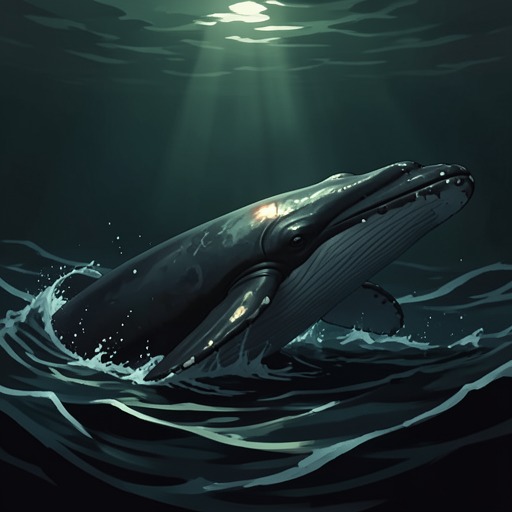
The WhaleThe whale as Leviathan is the mythic image of the whale as a power too immense and strange to be mastered by human categories. It emerges from the sea’s real scale and opacity, gathers meanings from religious and cultural traditions, and reaches its most ominous modern form in Moby Dick: not a friendly emblem of nature, but an overwhelming presence against which human dominion looks fragile.
The Sea as the Ground of the Myth
The image begins with the ocean itself. Henry David Thoreau describes it as an enduring wilderness, no less wild in the age of cities than in the distant past. Its apparent familiarity can conceal what lies beneath: the sea’s surface may look calm and continuous even as its depths hide creatures that remain unseen. In this account, the whale’s monstrous character is not simply invented by legend. It grows from an environment that human beings cross and use while knowing only a fraction of what it contains.
The sea is also presented as a force that gives and takes, capable of spectacle and punishment alike. It can rise in immense gestures or lie so still that it seems to vanish into the sky; either way, people encounter only a small part of its activity. The whale’s sudden appearance therefore turns an abstract sense of oceanic immensity into a visible body. Even the seasonal passage of humpbacks to the Gulf of Maine—an annual migration of as much as eight thousand miles—shows how whales inhabit oceanic routes and timescales beyond ordinary human movement. Their scale and mobility make the old image of the sea’s hidden monster legible without making the animal supernatural.
A Figure Shared Across Traditions
Stories from several traditions give the whale a scale that exceeds ordinary animal life. In the Jonah story, the great fish becomes the setting for human engulfment; in the tale of Sinbad, a whale’s back is mistaken for land, with sand and trees accumulated upon it. Lucian’s imagined whale extends the conceit further: one hundred and fifty miles long, it contains an entire nation, whose inhabitants believe themselves dead years after being swallowed. These stories make the whale not merely a predator but a world in its own right, a creature whose body can overturn the distinction between animal, landscape, and inhabited space.
The mythic whale also appears as an agent of catastrophe or rescue. In Greek myth, the sea creature sent by Poseidon to consume the young of Ethiopia is turned to stone after looking at Medusa; the episode is repeated in the seasonal appearance of the whale constellation over the southern horizon. In the Hindu flood story, Vishnu takes the form of a great fish with a horn and tows Manu and his ark to safety. Islamic tradition, meanwhile, counts the whale that swallowed Jonah among the ten animals that will enter paradise. The creature can thus threaten, contain, or preserve human life, without losing its association with overwhelming scale.
Apocalyptic and Cultural Meanings
Christian interpretation gives the whale a particularly charged relation to evil and salvation. D. H. Lawrence recasts Christ as Cetus and Christians as its little fishes, while the Christian era also treats the whale as the very shape of the Beast of Revelation. John Donne’s description of a monstrous animal with pillar-like ribs and a roof impervious to thunder turns anatomy into architecture: the whale’s body seems built on a scale that defeats ordinary weapons and weather. Across these traditions, the creature carries meanings larger than zoology, but those meanings remain anchored in the material image of a body that can engulf, shelter, or destroy.
Other cultural accounts place the whale within a contested natural world rather than a single religious scheme. North-Western American Indian beliefs describe giant waves carrying away villages as the backwash of battles between thunderbirds and whales. The image gives the whale a place among forces that shape the human environment, rather than making it simply an object within it. Taken together, these traditions do not settle on one meaning: they make the whale a figure through which different communities imagine danger, cosmic order, and the limits of human safety.
Moby Dick and the Modern Leviathan
In the modern imagination, the whale’s many inherited meanings converge most powerfully in Moby Dick. The novel’s White Whale is distinguished from the comforting anthropomorphism of smiling dolphins, performing orcas, singing humpbacks, and conservation campaigns. Seen through Ahab’s eyes, Moby Dick has an ominous shape and uncanny pallor; harpoons hanging from earlier hunters’ attempts make the animal appear marked by a history of failed human violence. The whale seems less like a familiar animal than an apocalyptic adversary, a dragon-shaped presence that Ahab would kill.
That image also concentrates the contradictions of whaling. For hunters, the whale meant money, food, livelihood, and trade; confronting it also meant risking death in a small boat against an immense body. It promised wealth and power while embodying disaster, and the encounter left whales near extinction. The Leviathan image therefore does not merely magnify the animal into a monster. It exposes the costs of treating a living being as resource and rival, and makes the whale’s apparent threat answer human violence with a scale of its own. The modern whale can signify innocence in an age of danger, yet Moby Dick resists that consoling role: its force lies in remaining other, immense, and not fully knowable.